
Why Do Kitchen Sinks and Garbage Disposals Back Up During the Holidays?
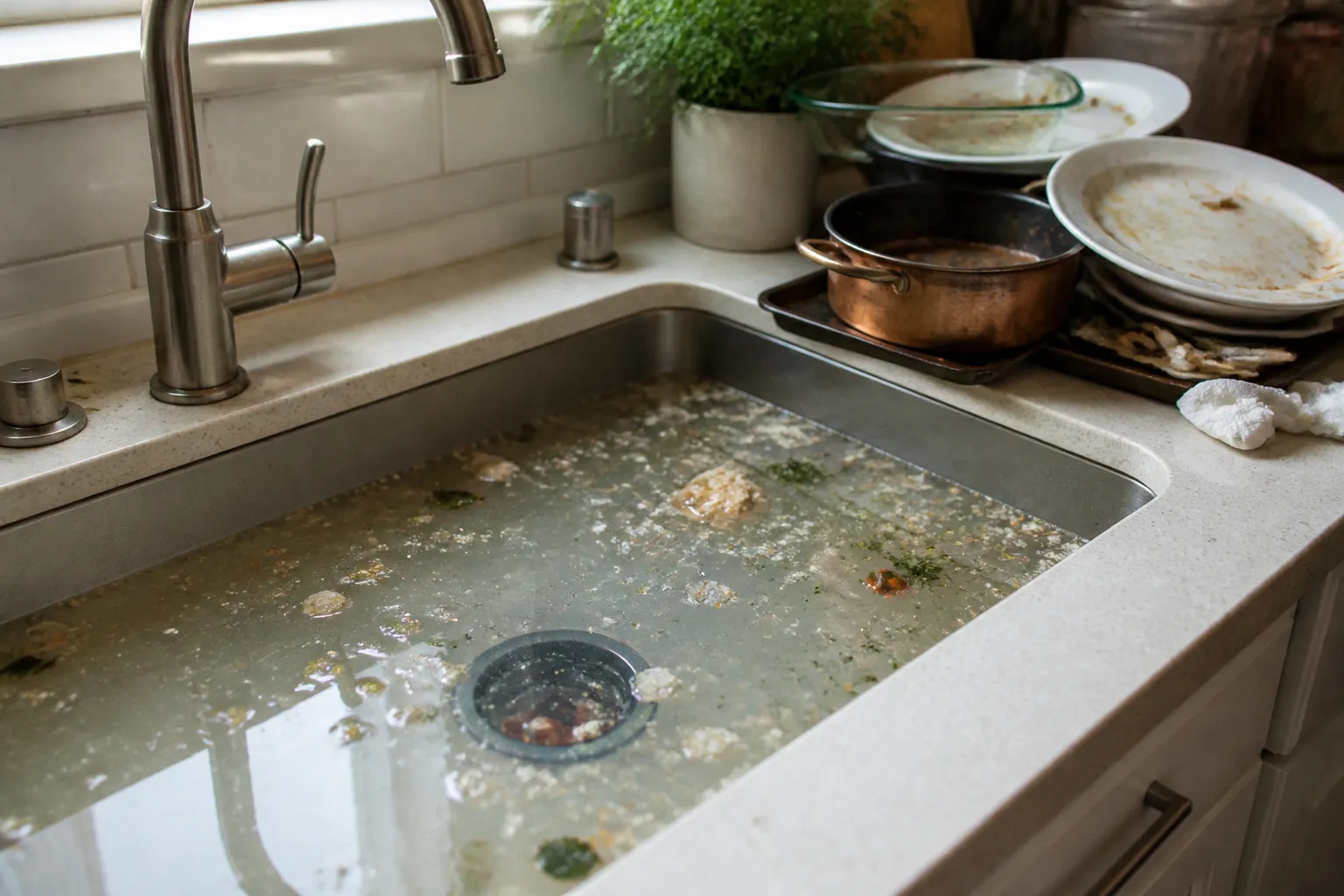
Kitchen sinks and garbage disposals are more likely to back up during the holidays because the plumbing handles more food waste, fats, oils, grease, dishwasher discharge, and overall use than it does on a normal day. If the kitchen drain already has buildup inside it, a busy day of cooking and cleaning can expose that restriction quickly.
A garbage disposal can grind appropriate food waste into smaller pieces, but it does not make grease safe for the drain or guarantee that food will pass through a partially clogged pipe. EPA guidance specifically notes that home garbage disposals do not keep grease out of the plumbing system. Grease can stick to pipe interiors and accumulate over time.
If your sink backs up while preparing a holiday meal, the important question is whether the problem is the disposal itself, the sink drain, the dishwasher connection, or somewhere farther down the drainage system.
In this article
- 1. Why Does Holiday Cooking Put More Stress on Kitchen Drains?
- 2. Does a Garbage Disposal Prevent Kitchen Drain Clogs?
- 3. Which Holiday Foods and Cooking Waste Deserve Extra Care?
- 4. Is the Garbage Disposal Clogged, or Is the Sink Drain Clogged?
- 5. Why Does Water Back Up Into the Other Side of a Double Sink?
- 6. Why Does My Kitchen Sink Back Up When the Dishwasher Drains?
- 7. What Warning Signs Can Appear Before a Holiday Kitchen Drain Fully Backs Up?
- 8. What Should You Avoid Putting Down the Drain During Holiday Cooking?
- 9. When Should You Stop Treating It as a Simple Disposal Problem?
- 10. When Might Hydrojetting Be Considered for a Kitchen Drain?
- 11. When Could a Holiday Kitchen Backup Be Part of a Bigger Sewer Problem?
Why Does Holiday Cooking Put More Stress on Kitchen Drains?
Holiday meals tend to concentrate a lot of kitchen activity into a short period.
A kitchen that normally handles breakfast, dinner, and a few dishes may suddenly be dealing with:
- Large amounts of cookware and serving dishes
- Meat drippings and fatty sauces
- More food scraps
- Repeated garbage disposal use
- More dishwasher cycles
- More water entering the drain within a shorter period
Heavy use may reveal a drain restriction that was already developing.
That helps explain why a sink can seem normal before Thanksgiving dinner and suddenly begin draining slowly later that evening. The holiday did not necessarily create the entire blockage in a few hours. Existing grease and debris may already have reduced the inside diameter of the drain.
Bryco’s professional drain cleaning service specifically addresses kitchen drains affected by grease, food debris, soap residue, and dishwasher residue.
Does a Garbage Disposal Prevent Kitchen Drain Clogs?
No. A garbage disposal can process appropriate food scraps, but it cannot prevent every drain clog.
Its job is to reduce certain food waste into smaller particles that can move into the drainage system. The disposal does not clean grease from the piping, repair a restricted drain, or guarantee that everything put into the sink will travel through the line successfully.
InSinkErator, for example, instructs users never to put fats, oils, or grease into the disposal and recommends running a moderate flow of cold water during operation. The manufacturer also notes that different disposal models are designed to handle different kinds of food waste.
That means the safest advice is to follow the instructions for your specific disposal rather than assuming every unit can process the same scraps.
What Happens When Grease Goes Down the Kitchen Drain?
Grease may enter the drain as a liquid or mixed with food residue, but it can adhere to pipe interiors and contribute to buildup.
The EPA identifies common grease sources including:
- Meat fats
- Cooking oils
- Butter and margarine
- Sauces
- Food scraps
- Dairy products
Over time, accumulated grease can narrow the available passage through the pipe and contribute to backups.
A garbage disposal does not solve that problem because grinding food and preventing grease accumulation are two different things.
Which Holiday Foods and Cooking Waste Deserve Extra Care?
The most broadly supported rule is simple:
Keep fats, oils, and grease out of the drain and garbage disposal.
EPA guidance recommends scraping grease and food scraps from cookware and plates into appropriate waste containers instead of washing them down the sink.
Other food-waste recommendations can vary based on the disposal model. Manufacturer guidance shows that some newer or more powerful units are designed to process foods that may not be recommended for other models.
For that reason, avoid treating the disposal as a general-purpose trash can during holiday cleanup.
A good rule is to:
- Follow the disposal manufacturer's instructions
- Avoid fats, oils, and grease regardless of disposal model
- Avoid forcing large amounts of food waste through at once
- Remove non-food items before they reach the disposal
- Pay attention if drainage is already becoming slower
Is the Garbage Disposal Clogged, or Is the Sink Drain Clogged?
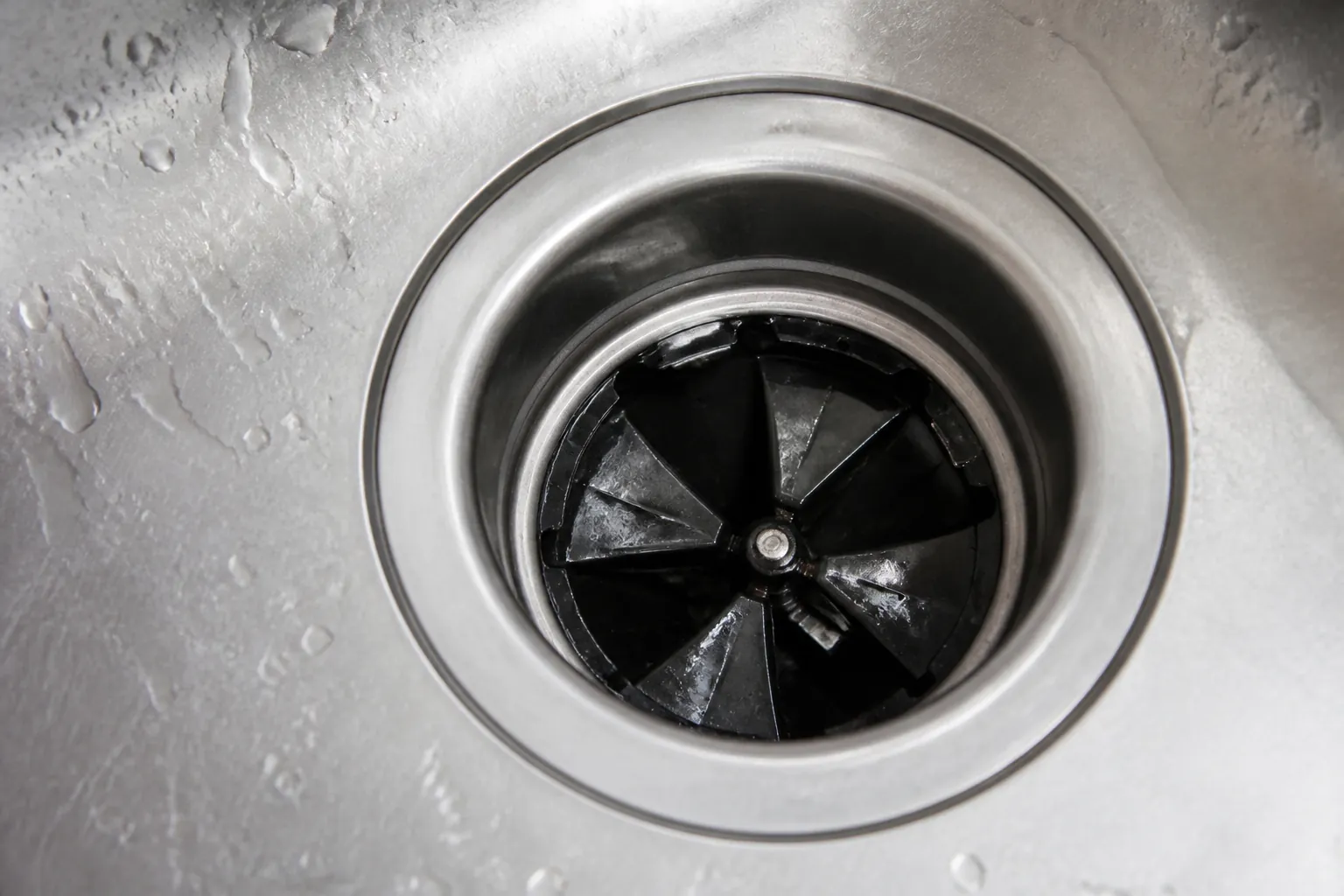
This distinction matters because a working disposal does not prove the drain is clear.
At a Glance
| Symptom | May Point More Toward the Disposal | May Point More Toward a Drain Restriction |
|---|---|---|
| Disposal hums but does not grind | Yes | Not usually the primary issue |
| Disposal does not operate | Possible disposal/electrical issue | Not usually the primary issue |
| Disposal runs normally but sink remains full | Less likely to be only the motor | Yes |
| Water rises in the second sink basin | Usually not a disposal motor problem | Often |
| Sink backs up when dishwasher drains | Could involve disposal connection | Downstream restriction should be considered |
| Same kitchen drain repeatedly clogs | Depends | Deeper buildup or another drain problem may need evaluation |
| Disposal leaks underneath | Yes, disposal or connection should be inspected | Possibly separate from the clog |
This table provides general clues, not a diagnosis.
Bryco’s kitchen plumbing services include kitchen sink, dishwasher, garbage disposal, and kitchen-drain work, which makes it possible to evaluate the system rather than assuming the disposal needs replacement.
Why Does Water Back Up Into the Other Side of a Double Sink?
If both sink basins connect to the same downstream drain, a restriction after that connection can cause water to appear in the opposite basin.
You may run the disposal on one side and see dirty water rise in the other.
That is an important clue because it often means the problem is not simply that one basin cannot drain. Water is reaching a shared restriction and finding another available path.
A plumber may need to determine whether the blockage is:
- Near the disposal connection
- In the trap or nearby piping
- Farther down the kitchen branch drain
Simply replacing a disposal would not correct a restriction located downstream from it.
Why Does My Kitchen Sink Back Up When the Dishwasher Drains?
Your dishwasher has to discharge its wastewater into the kitchen drainage system. If that path is restricted, dishwasher discharge can make water rise in the sink instead of flowing away normally.
Depending on the installation, the problem may involve:
- The dishwasher drain hose
- An air-gap arrangement where present
- The disposal connection
- Sink drain piping
- A downstream kitchen drain restriction
Does That Mean the Dishwasher Is Broken?
Not necessarily.
If the dishwasher completes its cycle but wastewater appears in the sink, the drainage path deserves attention before assuming the appliance itself has failed.
This is another reason the symptoms should be evaluated as a system.
What Warning Signs Can Appear Before a Holiday Kitchen Drain Fully Backs Up?
A sink often gives some warning before it stops draining completely.
Watch for:
- Drainage getting progressively slower
- Gurgling after water goes down
- Water lingering in the disposal side
- Water briefly rising in a second basin
- Sink backup during dishwasher discharge
- Repeated minor clogs
- Drain odors accompanying slow drainage
A sink that becomes slightly slower during ordinary use may have enough capacity to keep functioning.
Heavy holiday cooking can change that quickly.
What Should You Avoid Putting Down the Drain During Holiday Cooking?
The most important item to keep out is fats, oils, and grease.
Instead of rinsing cooking grease into the sink, EPA guidance recommends scraping or collecting it for proper disposal. The EPA also recommends using drain baskets or strainers to capture solid food scraps.
It is also sensible to avoid overwhelming the disposal with large volumes of waste at once.
When using a disposal, follow the manufacturer’s operating instructions. InSinkErator recommends running cold water while grinding and allowing water to continue briefly afterward.
Different models have different grinding capabilities, so manufacturer guidance should take priority over generic online lists of foods that supposedly “always” or “never” belong in every disposal.
When Should You Stop Treating It as a Simple Disposal Problem?
If the disposal runs but the sink still cannot drain, the problem may be farther downstream.
Other warning signs include:
- Water backing into another basin
- Repeated kitchen clogs
- Dishwasher discharge causing a backup
- Gurgling farther along the drainage system
- More than one fixture beginning to drain slowly
At that point, professional drain cleaning may be more appropriate than continuing to focus on the disposal.
Bryco’s drain-cleaning page distinguishes ordinary branch-drain clogs from recurring problems and broader main-line symptoms.
When Might Hydrojetting Be Considered for a Kitchen Drain?
Hydrojetting may be considered when substantial grease or other buildup coats an appropriate drain line, particularly when recurring restrictions are not being resolved by ordinary clearing.
It is not automatically necessary for a holiday sink clog.
Bryco’s hydrojetting service is positioned for more difficult buildup, including grease, scale, and recurring drain problems. The current Drain Cleaning page similarly describes hydrojetting as a next-step option for tougher accumulation rather than the starting point for every clog.
The appropriate cleaning method depends on:
- Location of the restriction
- Amount and type of buildup
- Pipe size
- Pipe condition
- Whether the problem keeps returning
When Could a Holiday Kitchen Backup Be Part of a Bigger Sewer Problem?
A problem limited to the kitchen usually points first toward the kitchen drainage path.
A broader drainage problem becomes more plausible if the kitchen backup is joined by symptoms elsewhere, such as:
- Multiple drains slowing at the same time
- Toilets gurgling when other fixtures drain
- Shower or floor-drain backup
- Repeated problems shortly after cleaning
Bryco’s Drain Cleaning page identifies multiple simultaneous backups and recurring drainage problems as signs the issue may extend beyond one fixture.
If the problem repeatedly returns and the cause is not obvious, a sewer video inspection may be useful for evaluating conditions farther inside the line.
Holiday Kitchen Backup in Woodland Hills? Find the Restriction Before Replacing the Disposal
A backed-up kitchen sink does not automatically mean the garbage disposal has failed.
The restriction could be:
- At the disposal
- In the sink piping
- At the dishwasher discharge connection
- In the kitchen branch drain
- Farther downstream
Bryco Plumbing provides kitchen plumbing services and drain cleaning for Woodland Hills and surrounding service areas.
If the kitchen sink keeps backing up, the disposal runs but water will not drain, or holiday cooking has brought an existing drainage problem to the surface, request a quote to have the problem evaluated.
Frequently Asked Questions
Why does my garbage disposal run but the sink still not drain?
The disposal can operate normally while the drain beyond it is restricted. Grease, food debris, or another obstruction in downstream piping may prevent water from leaving the sink even though the disposal motor and grinding components still work.
Why does water come up in the other side of my double sink?
The two basins often connect to a shared drain. A blockage downstream from that connection can cause water to rise through the opposite basin instead of flowing away.
Can grease really clog a kitchen drain?
Yes. EPA guidance states that grease can stick to the inside of sewer pipes and accumulate until flow is significantly restricted or blocked.
Should I use hot or cold water while running my garbage disposal?
Follow the instructions for your particular unit. InSinkErator recommends a moderate flow of cold water during grinding and continuing the water briefly after grinding is complete.
Does a dishwasher backing up into the sink mean the dishwasher is broken?
Not necessarily. The dishwasher’s wastewater needs a clear drainage path. A restriction at the disposal connection, sink drain, or farther downstream can cause water to appear in the sink even if the dishwasher itself is operating.
Does every recurring kitchen clog need hydrojetting?
No. Hydrojetting is one possible cleaning method, not the automatic answer to every clog. The plumber should consider the cause, location, buildup, and pipe condition before recommending a cleaning method.
Written by the team at Bryco Plumbing. Serving Woodland Hills, CA; Los Angeles, CA; San Fernando Valley, CA; Ventura County, CA; Van Nuys, CA; Encino, CA; Burbank, CA; North Hollywood, CA; Sherman Oaks, CA; Beverly Hills, CA; Calabasas, CA; Canoga Park, CA; Valencia, CA; Granada Hills, CA; Northridge, CA; Mission Hills, CA; West Hills, CA; Hollywood, CA; Agoura Hills, CA; Pasadena, CA; Camarillo, CA; Studio City, CA.
Questions? Call (833) 765-2245 or visit bryco-plumbing.com.