Restoration After a Summer Water Damage Event in Woodland Hills: The First 48 Hours
By Bryco Plumbing • Aug 07, 2026 • Serving Woodland Hills, CA, Los Angeles, CA, San Fernando Valley, CA
The first 48 hours after a plumbing water damage event determine whether you have a $2,000 problem or a $30,000 one. That number is not exaggerated — it comes from insurance claims data across the Woodland Hills, Los Angeles, and San Fernando Valley area over the last five years.
This is the practical, hour-by-hour playbook for what to actually do in your Woodland Hills, Calabasas, or Encino home the moment you realize the ceiling is dripping — before the restoration crew arrives and after they leave.
In this article
- Hour 0–1: stop the water, document everything
- Hour 1–6: contain and call
- Hour 6–24: extraction and airflow
- Hour 24–48: the mold decision window
- The hidden damage: HVAC and electrical
- Working the claim
- Bottom line for Woodland Hills homeowners
Hour 0–1: stop the water, document everything
The single highest-value hour of the entire process.
Shut off the water
Every homeowner should know exactly where their main shutoff is before an emergency — but the day-of reality is that most don’t. Look on the exterior wall near the front hose bib, or in a small box between the house and the sidewalk.
If you can’t find it, shut off the individual fixture supply valves and call — we can walk you through the meter shutoff over the phone.
Photograph before you touch anything
Insurance adjusters see hundreds of claims a year. A homeowner who has good time-stamped photos of every affected area — before any cleanup starts — has a dramatically better claim outcome than one who doesn’t.
Video works too. Talk through the damage as you walk. It takes ten minutes and it is the single most useful thing you can do.
Hour 1–6: contain and call
The clock starts on secondary damage the moment water hits materials.
Move what you can
Wet paper, books, and electronics have a very short recovery window. Move them out of the affected area immediately.
Furniture with wood legs on wet carpet stains quickly. Raise legs on foil, plastic caps, or shims within the first hour.
Call insurance and restoration in parallel
Your insurer wants to know immediately. Your restoration crew also needs to be moving immediately. These two calls happen in parallel, not sequence.
In Woodland Hills we recommend restoration equipment on-site within 6 hours. Every additional hour raises the odds of mold within the mitigation window.
Hour 6–24: extraction and airflow
This is the mitigation window. Everything you do here either prevents mold or accelerates it.
Water extraction first, drying second
Standing water and saturated carpet pad must be extracted before drying equipment goes in. Skipping the extraction and just running fans is a common shortcut that costs weeks of drying time and often triggers mold.
A commercial extractor is not the same tool as a shop vac.
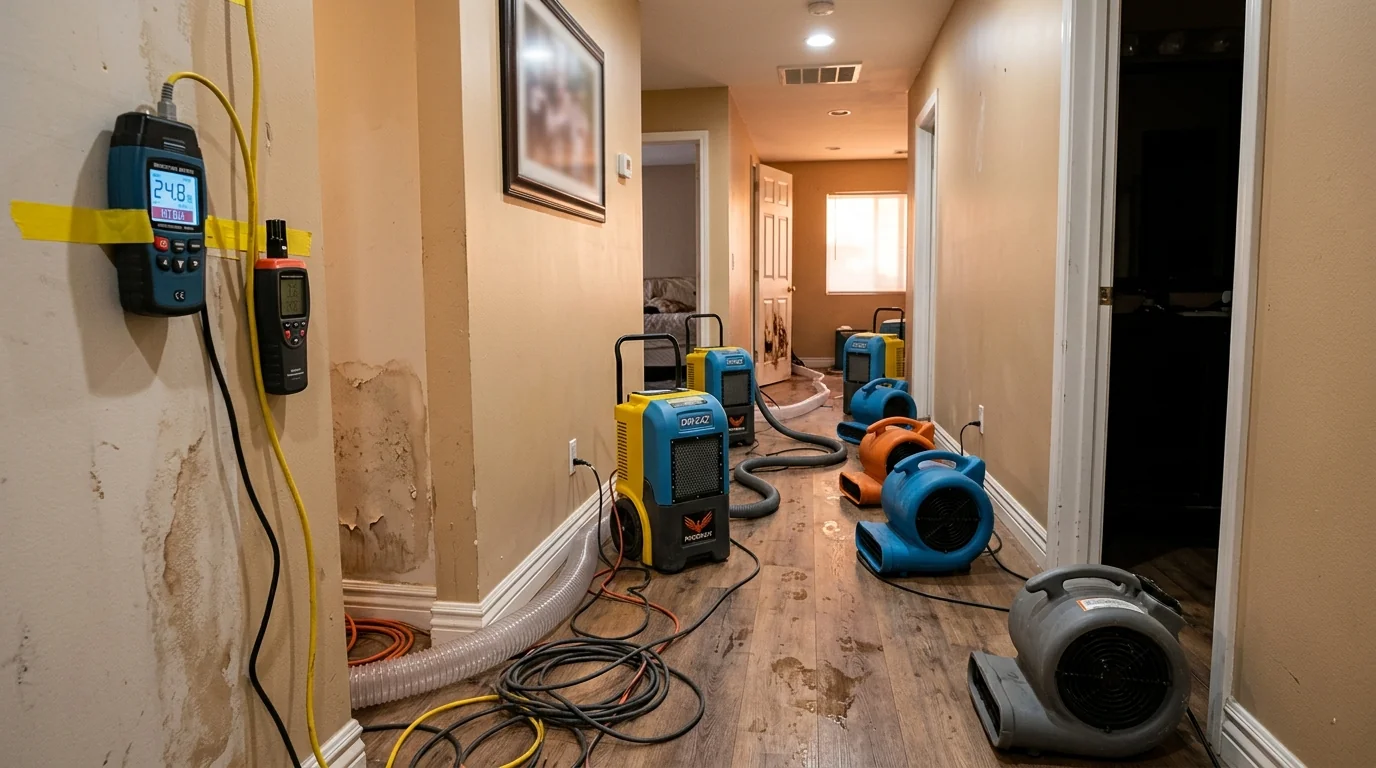
Air movers plus dehumidifiers
The mistake is thinking fans alone dry things. Fans move water into the air. If that air isn’t being pulled out by dehumidifiers, you’re relocating moisture into your walls.
Every restoration setup we run across the SFV pairs air movers with high-capacity dehumidifiers, monitored daily.
Hour 24–48: the mold decision window
By 48 hours, materials that have not dried are candidates for removal rather than salvage.
Drywall and baseboards
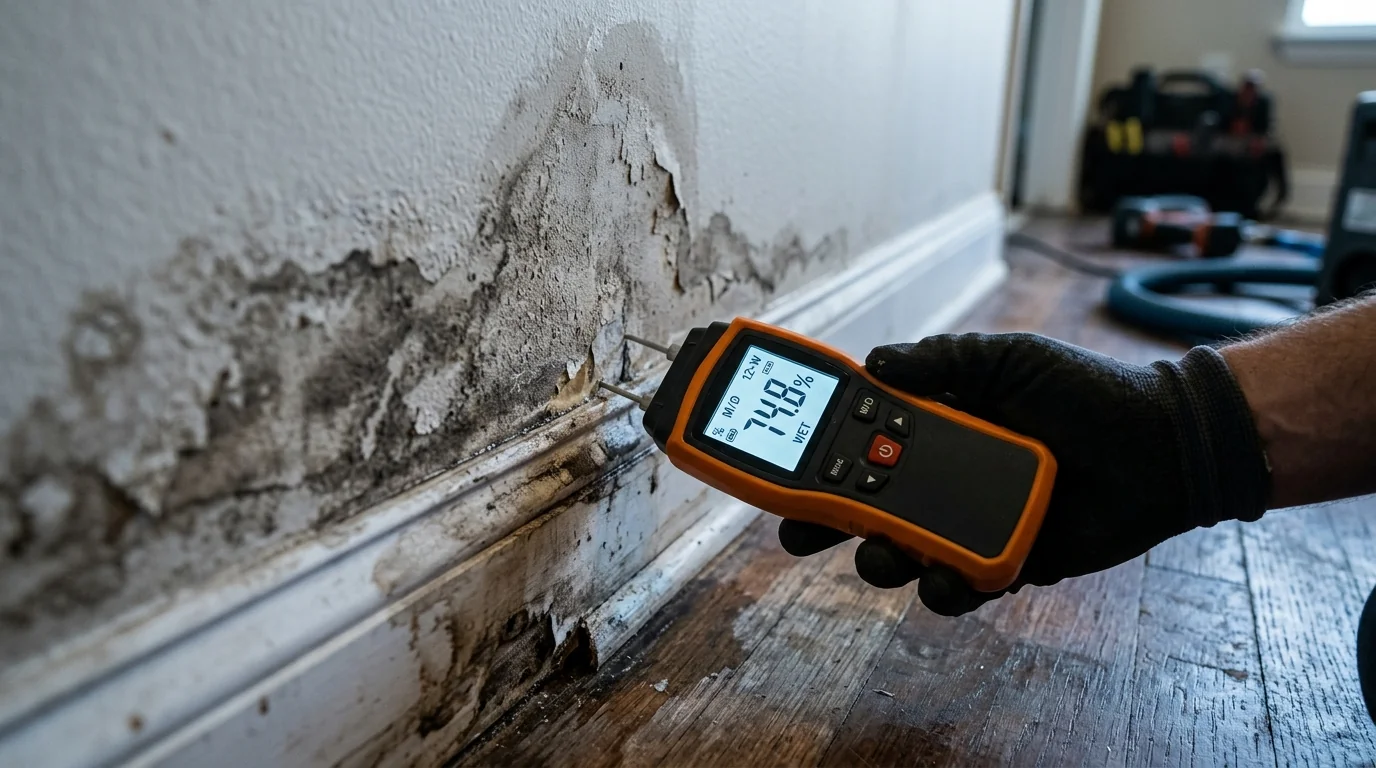
Wet drywall wicks water upward for hours. By day two, a moisture meter reading above 17% at 24 inches up from the floor typically means the drywall is coming out — cutting it at 2 or 4 feet is standard practice.
That decision made at hour 30 saves weeks of remediation compared to trying to dry it and failing at day 10.
Carpet pad vs. carpet
Carpet pad rarely survives more than 24 hours of saturation and is inexpensive to replace. The carpet itself often can be dried in place if extraction happened quickly.
The temptation to save the pad is almost always a false economy.
| Time Window | Priority Action | What Not to Do |
|---|---|---|
| Hour 0–1 | Shut off water, photograph everything | Don’t start cleanup yet |
| Hour 1–6 | Call insurance + restoration in parallel | Don’t wait for one before starting the other |
| Hour 6–24 | Water extraction + air movers + dehumidifiers | Don’t rely on fans alone |
| Hour 24–48 | Decide on drywall/pad removal | Don’t try to save saturated materials |
| Ongoing | Daily documentation for claim | Don’t skip the paper trail |
The hidden damage: HVAC and electrical
Two systems homeowners routinely forget to check.
HVAC ductwork
If a ceiling leak dripped into an attic-run duct system, that duct is contaminated. Running the HVAC circulates that moisture throughout the house and, if mold sets in, through every room.
The HVAC system should be inspected before it’s turned back on after any significant water event.
Electrical outlets and boxes
Any outlet or junction box that got wet should be inspected by a licensed electrician before the breaker is restored. Water inside a box can look dry from the outside days later.
This is a small line item in the total but it’s the one that turns a water damage event into a fire risk if skipped.
Working the claim
The paperwork side of restoration is where most homeowners either recover fully or don’t.
- Document every day. Moisture readings, equipment logs, before/after photos. A reputable restoration company provides this automatically. If yours doesn't — ask.
- Get scope in writing. Ask specifically whether the restoration scope includes final cleaning, HVAC inspection, and mold clearance testing before rebuild.
- Written scope over $10K. For any water damage event over about $10,000, get a written scope before authorizing work.
Water Damage? Every Hour Counts.
Restoration equipment on-site in under 4 hours across Woodland Hills, Calabasas, Encino, Sherman Oaks, Van Nuys & the greater San Fernando Valley. 24/7 emergency response.
Bottom line for Woodland Hills, CA homeowners
The difference between an inexpensive outcome and an expensive one is usually the timing of your first phone call. In the SFV, that decision window is often measured in hours, not days.
If you noticed any of the warning signs in this guide, treat it as a same-hour action, not a same-day one. The cost of getting extraction started is small compared to the cost of skipping it.
When you speak with a technician about water damage restoration in Woodland Hills, ask specifically what they’ve seen in your immediate area over the last twelve months. That question separates local expertise from generic advice.
Frequently Asked Questions
How fast can restoration equipment be on-site in Woodland Hills?
For confirmed water damage events across Woodland Hills, Los Angeles, and the SFV, our standard is under 4 hours from the call. Call (833) 765-2245 any hour of the day.
Will insurance cover water damage restoration?
Sudden events are almost universally covered under a standard homeowner’s policy. Gradual leaks may not be. Documentation matters enormously either way.
How long does the restoration process take?
For a typical single-room event, 3–7 days of mitigation is standard. Larger events with structural drying can run 2–4 weeks.
Do I need mold testing after a water damage event?
For any event where materials were wet more than 48 hours, a mold clearance test before rebuild is a reasonable step. It’s inexpensive relative to the downside of missing it.
Can I stay in my house during restoration?
Usually yes for smaller events. For events involving multiple rooms or HVAC contamination, a short displacement is often more comfortable and typically covered by insurance.
What's the biggest mistake homeowners make in the first 24 hours?
Trying to handle it themselves with towels and fans before calling for extraction. It doesn’t save money — it costs weeks of drying time and often triggers mold.